Phytoplankton in wind-mixed layers
Phytoplankton are known to adapt to varying irradiance. In a
wind-mixed surface layer, this photoresponse can change the integrated
productivity of the water column. To explore this phenomenon, Dr. John
Marra of the Lamont-Doherty
Earth Observatory and I developed a new formulation for the
phytoplankton photoresponse. We then incorporated this model into a
wind-driven mixed-layer model.
The mixing model showed that the modelled photoresponse could
increase the integrated production under certain conditions of wind
forcing and diffuse attenuation of irradiance.
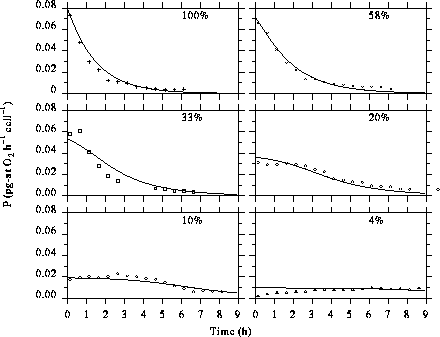
- Time response of phytoplankton photosynethesis under constant irradiance. Data for plots from Marra (1978a, b)
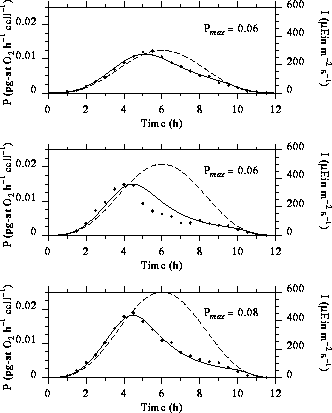
- Time response of phytoplankton photosynethesis (solid line, dots)
under varying irradiance
(dashed line).
- Time response of phytoplankton photosynethesis (solid line, dots)
under fluctuating irradiance
(dashed line).
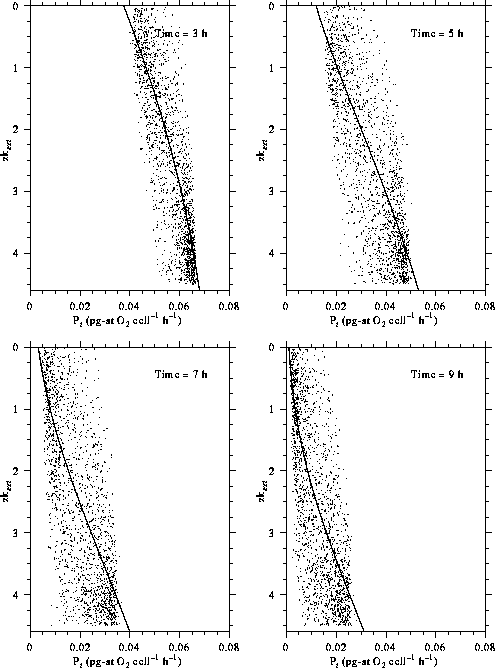
- Vertical distribution of
instantaneous photosynthetic rate of 2000 cells in a wind-driven
mixed layer at 4 times during the day. Solid line is no wind mixing
- Vertical distribution of
Pmax of the same cells. Solid line is no wind mixing.
- Animation of
photosynthetic rate of 2000 cells in wind-mixed layer
- Animation of Pmax
of cells from above animation
This work was funded in part by U.S. GLOBEC
Franks, P.J.S. and J. Marra. 1994. A simple new formulation for
phytoplankton
photoresponse and an
application in a wind-driven mixed-layer model.
Marine
Ecology Progress Series 111:143-153.
E-mail below for a reprint
Home Previous
Peter J.S. Franks pfranks@ucsd.edu
Scripps Institution of Oceanography
University of California, San Diego
La Jolla, CA 92093-0218