 Chaotic Mixing
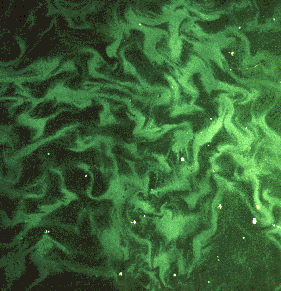
. Patterns in a bloom of Anabaena flos-aquae.
Chaotic Mixing
. Patterns in a bloom of Anabaena flos-aquae. Animation of the "blinking vortex" chaotic flow. Note the similarities of some of the patterns with the image above.
Intricate and striking patterns are often created in dense algal blooms by the interaction of sinking, floating, or swimming algae and local physical dynamics. The structure of these patterns can reveal a great deal about the processes underlying the pattern formation. Here I explore three common patterns in dense algal blooms: chaotic mixing, internal wave banding, and sharp fronts. For each of these patterns, I develop a simple model to simulate the qualitative aspects of the patterns. The models are then analyzed to better understand the time and space-dependent processes involved in pattern formation, and to suggest ways in which we might better sample such patterns to more accurately quantify the dynamics.
Simple, deterministic, time-dependent flows can generate chaotic patterns of Lagrangian tracers. Chaotic motion of the water itself is not required to achieve fantastic patterns of tendrils and whorls of an advected patch.
Chaotic Mixing
. Patterns in a bloom of Anabaena flos-aquae.
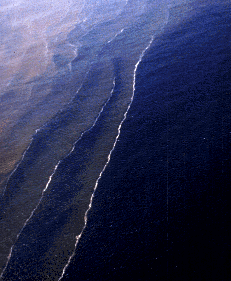
Animation of the "blinking vortex" chaotic flow. Note the similarities of some of the patterns with the image above.The formation of bands of high phytoplankton concentration is quite evident in the animation below as the waves propagate onshore (to the right). As predicted by other authors (e.g., La Fond, 1962; Gill, 1982), the bands propagate with the same speed and direction as the underlying wave. The bands form at the trough of the wave, just behind the zone of maximal convergence (La Fond, 1962). The waves do not carry individual cells along with them - the patches are formed and reformed constantly, as new cells are drawn into and out of patches. There is no net advection of cells in any direction.
 Internal Wave Banding
. These bands are high concentrations of Lingulodinium polyedrum (Gonyaulax polyedra) formed by underlying internal waves.
Internal Wave Banding
. These bands are high concentrations of Lingulodinium polyedrum (Gonyaulax polyedra) formed by underlying internal waves. Animation of bands of plankton forming in the troughs of a high-frequency internal wave. The upper panel is a cross section of the wave showing the displacement of the pycnocline. The lower panel is an aerial view of the concentrations of floating cells.
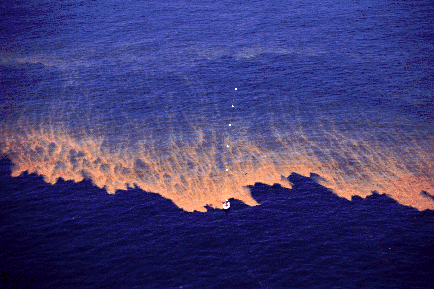
The accumulation of swimming organisms at an ageostrophic front can be a very efficient mechanism to transport organisms to the shore. As the front propagates, it effectively "vacuums" the waters beneath it of cells, focusing the cells to a narrow zone following the front. There are numerous mechanisms that could form such a front, including release of a tidally-generated density jump, relaxation of wind-driven upwelling or spreading of a buoyant plume.
 Ageostrophic Front
. A bright band of Noctiluca scintillans accumulating in an ageostrophic front propagating onshore.
Ageostrophic Front
. A bright band of Noctiluca scintillans accumulating in an ageostrophic front propagating onshore. Animation of a band of plankton forming in an ageostrophic front. The coordinate system is moving with the front, so the water appears to move to the left, underneath the front.
Franks, P.J.S. Spatial patterns in dense algal blooms.
Limnology and Oceanography, in press